How LoRa Chirp-Spread-Spectrum Technology Works?
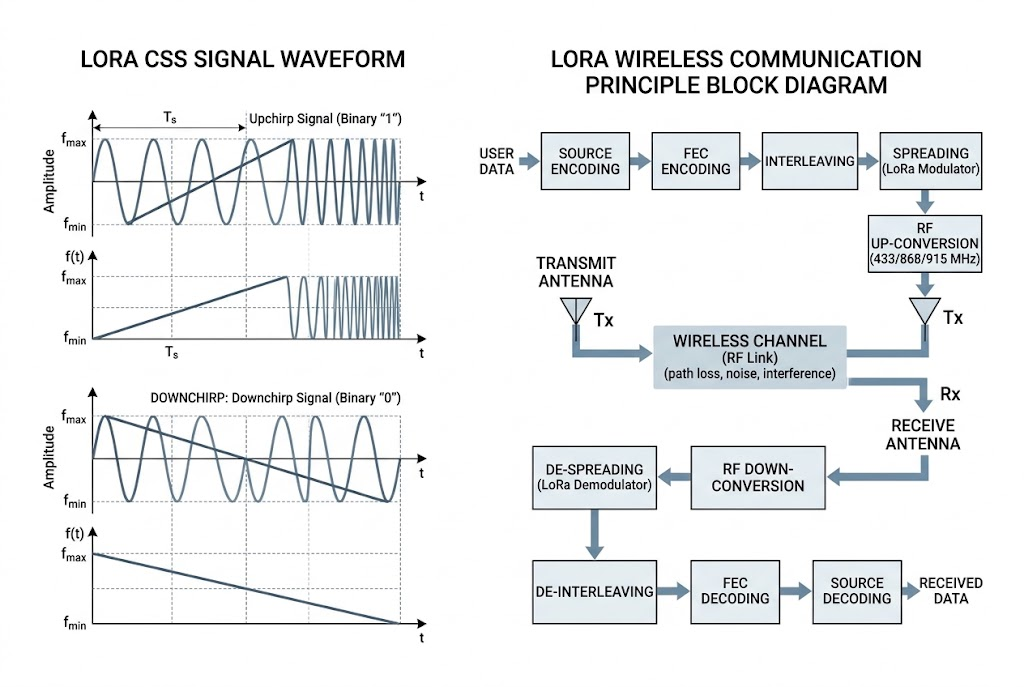
LoRa, short for Long Range, is a representative LPWAN (Low-Power Wide-Area Network) wireless technology developed based on Chirp Spread Spectrum (CSS) modulation. Unlike traditional FSK modulation, CSS encodes data into variable-frequency chirp signals. Even under weak signal and heavy radio interference, LoRa can still decode valid data, achieving receiver sensitivity as low as -148 dBm.
Operating within unlicensed ISM frequency bands such as 433 MHz, 868 MHz and 915 MHz, LoRa balances transmission distance and power consumption well. In open-field environments, point-to-point communication distance can reach 10 15 km, while battery-powered sensor nodes can run for multiple years without frequent battery replacement.
It is important to distinguish LoRa physical layer technology from LoRaWAN protocol. LoRa defines radio-level signal modulation; LoRaWAN is the upper layer network protocol standardized by LoRa Alliance, which manages node access, data encryption and gateway forwarding. For private deployment, many manufacturers adopt self-defined UART transparent transmission mode instead of LoRaWAN. This flexible feature makes LoRa widely used in custom industrial wireless data transmission equipment, remote sensor collection and asset monitoring projects worldwide.