How to Choose the Right IoT Wireless Technology?
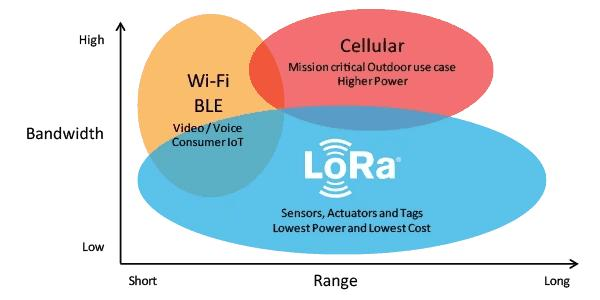
The Internet of Things industry has multiple mature wireless communication technologies, and each solution has its own applicable boundaries. Many developers and project investors feel confused when selecting communication schemes. By comparing LoRa with Wi-Fi, Bluetooth Low Energy (BLE) and NB-IoT, we can clearly judge when LoRa is the optimal choice.
Wi-Fi is famous for high transmission speed, supporting video and large data transmission. However, its transmission distance is limited within 100 meters, power consumption remains high, and continuous power supply is usually necessary. It fits indoor smart home and office equipment but is not suitable for scattered outdoor sensor networks. BLE features low power consumption, yet the effective distance is only dozens of meters, mostly used for wearable devices and short-distance equipment pairing.
NB-IoT is cellular LPWAN technology operated by communication carriers. It realizes nationwide wide coverage based on existing base stations, but every device generates ongoing traffic subscription fees. For projects with thousands of sensor nodes running for 5–10 years, cumulative service charges will become a heavy burden. In addition, NB-IoT cannot work normally in regions without cellular base station coverage.
LoRa occupies a unique market space between these technologies. It achieves kilometer-level communication range with ultra-low power consumption. Users can build private networks independently without continuous traffic costs. The obvious trade-off is low transmission speed, which means LoRa only adapts to equipment sending small sensor data intermittently.
We can summarize clear selection rules: Choose Wi-Fi for high-speed short-range data transmission; pick BLE for short-distance device interaction; select NB-IoT if you need cross-city wide-area coverage and accept recurring fees. If your project requires outdoor long-distance monitoring, battery-powered sensors, independent network deployment and controllable long-term operating expenses, LoRa is undoubtedly the most cost-effective solution.
With flexible hardware supply and mature open protocols, LoRa maintains strong competitiveness in industrial, agricultural and environmental IoT markets.