Comparison in coverage and range about LoRa and Sigfox
Hi there! We are going to make a brief comparison in coverage and range about LoRa and Sigfox today.
1. Coverage Area
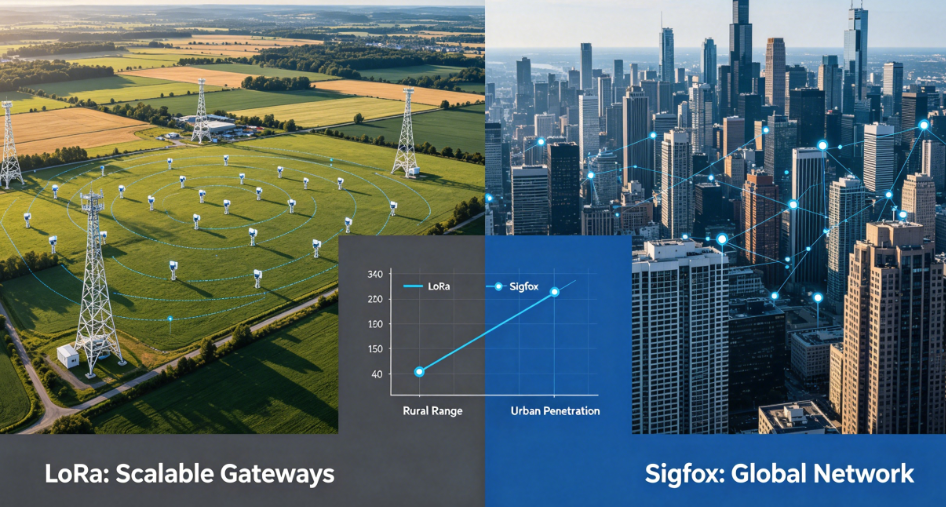
LoRa's coverage is determined by various factors including the deployment environment, antenna height, spreading factor, and network design. It is designed to cover large areas, making it suitable for rural, suburban, and urban deployments.
Sigfox is designed to provide wide-area coverage using a network of base stations. The goal is to create a global network that allows devices to connect from anywhere within the coverage area.
Sigfox operates its own network infrastructure, which is continuously expanded by Sigfox and its local operators.
2. Transmission Range
LoRa:
Rural Areas: In open rural areas, LoRa can achieve a range of up to 15 kilometers (approximately 9 miles) or more.
Urban Areas: In urban settings, the range is typically reduced to 2-5 kilometers (approximately 1-3 miles) due to buildings and other structures that can cause signal attenuation and multipath effects.
Dense Urban Environments: In very dense urban environments, the range may be further limited to 1-2 kilometers (approximately 0.6-1.2 miles) because of the increased number of obstacles.
Sigfox:
Rural Areas: Sigfox can achieve a range of up to 30-50 kilometers (approximately 18-31 miles) in open rural areas.
Urban Areas: In urban settings, the range is typically around 3-10 kilometers (approximately 1.8-6.2 miles), depending on the density of buildings and other structures.
Dense Urban Environments: In dense urban environments, the range may be reduced to about 1-3 kilometers (approximately 0.6-1.8 miles) due to increased signal obstruction and interference.
3. Factors Affecting Range:
LoRa:
Spreading Factor (SF): Higher spreading factors increase the range by making the signal more robust to interference and noise, but they also reduce the data rate.
Antenna Height and Type: Increasing the height of the antennas used by both the gateway and end devices can significantly improve the range. Directional antennas can also enhance range in specific directions.
Sigfox:
Ultra-Narrowband Technology: Sigfox uses ultra-narrowband (UNB) technology, which transmits signals over very narrow frequency channels (typically 100 Hz). This allows for long-range communication by reducing the noise floor and increasing sensitivity.
4. Coverage Scalability
LoRa:
The coverage of a LoRa network can be expanded by adding more gateways. This scalability makes it suitable for applications ranging from local to regional and national deployments.
Sigfox:
Sigfox aims to provide seamless global coverage, allowing devices to operate across different countries without needing changes in configuration. This is achieved through a network of base stations deployed by Sigfox and its partners worldwide.